
Games as a Product Layer on hi-rummy
The games section on hi-rummy should not be read as a single category. It is a mixed system composed of different interaction models. Some games are fully RNG-driven, some combine probability with decision-making, and others introduce real-time interaction through live streaming or event-style mechanics. Treating them as one unified experience leads to incorrect assumptions, especially when users move between formats within the same session.
Roulette, Blackjack, Poker, Bingo, Live casino, and Aviator do not operate under identical logic. They share a platform environment, but their internal structures differ significantly. A clean product page should reflect that difference instead of flattening it into a generic “games” label.
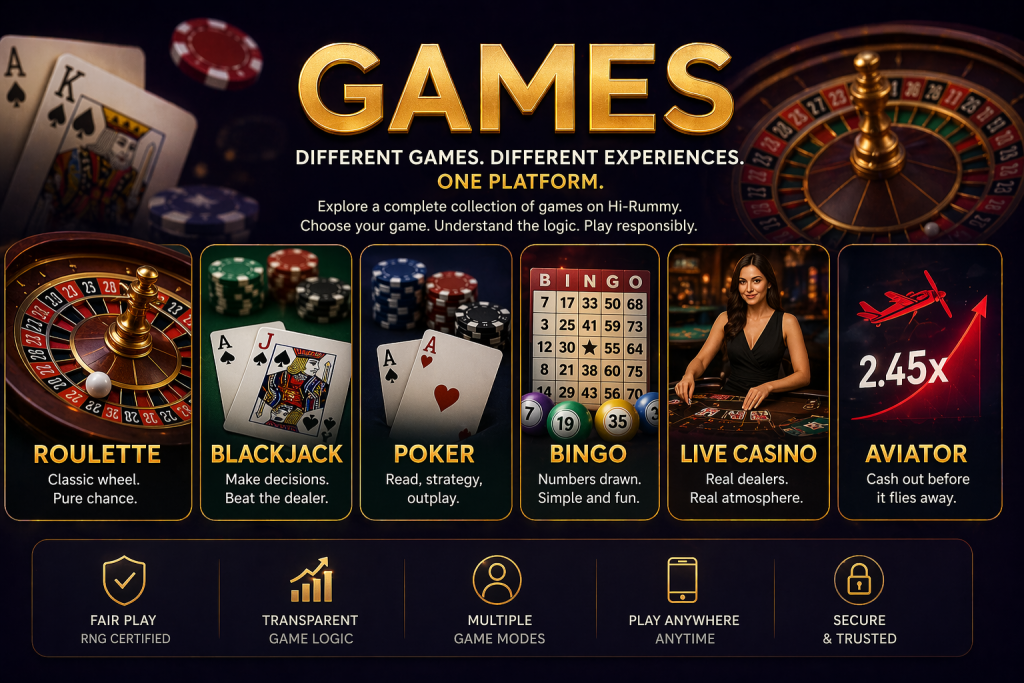
RNG-based games such as Roulette rely on independent outcomes. Each round is calculated without memory. There is no carryover effect from previous spins. Blackjack and Poker introduce decision layers, but even there, probability remains the governing framework rather than any predictable pattern. Bingo operates on a distribution model where outcomes are tied to number generation sequences rather than sequential betting logic.
Live casino introduces another layer. It connects the same mathematical structure to a real-time interface with a dealer. The presence of a human element changes perception, but not the underlying probability model. Users often interpret live environments as more “controlled” or “responsive,” but the system logic remains bounded by predefined rules.
Aviator and similar crash-style games introduce a different reading pattern. They create a continuous curve where users decide when to exit rather than waiting for a discrete result. This shifts attention from outcome interpretation to timing decisions. However, the underlying generation of the multiplier curve is still governed by probabilistic logic, not by user behaviour or previous rounds.
The key separation remains the same across all formats:
the outcome engine operates independently, while the user interface and interaction model shape perception. Understanding this separation is essential before comparing any game type.
Game Session Structure
This chart shows how different game formats on Hi-Rummy create different levels of session density, timing pressure, and interpretation load. It does not measure value or advantage. It reflects structural intensity.
Catalogue Structure Across the Hi-Rummy Games Shelf
The Hi-Rummy games shelf becomes easier to use when the catalogue is organised around interaction logic rather than broad entertainment language. Users do not experience Roulette, Blackjack, Poker, Bingo, Live casino, and Aviator in the same way, even if they appear under one page heading. Each format creates a different kind of attention pattern. Some rely on clean round resolution. Some require active decisions. Some place more emphasis on real-time presentation. Others create timing pressure through event-based mechanics. A page that presents these formats as if they belong to one seamless model becomes less useful, because it hides the very differences that help users understand what they are opening.
Roulette usually works as a low-friction entry format because the interface is direct. The user selects a position, the round resolves, and the result is immediately visible. The reading pattern is stable and the surface is clear. Blackjack introduces a stronger decision layer, so the user is not simply waiting but actively responding to the structure of the hand. Poker adds even more interpretive density because sequencing, position, and comparative actions become part of the experience. Bingo tends to be perceived as lighter because the interface often feels simpler and more communal, yet the session still depends on distribution logic rather than user-led control.
Live casino changes the atmosphere rather than the core rule frame. The presence of a dealer and a table camera can make the session feel more grounded and immediate, but this should not be confused with a change in mathematical logic. The user is reacting to presentation, not to a more controllable outcome environment. Aviator changes the reading model in a different direction. It compresses attention into a timing event, so users often focus more intensely on streaks, exit points, and recent round behaviour. That can create stronger interpretation pressure than classic table formats even though probability still defines the environment.
A searchable catalogue is useful here because it lets the page work as a navigational tool instead of a decorative content block. A user should be able to identify which formats are round-based, which are decision-led, which are live-presented, and which are timing-sensitive. On mobile this matters even more, because a flat list of names provides very little help. Once the table carries format role, session tone, and reading model, the page becomes more functional and more credible.
The table below treats the Hi-Rummy games shelf as a structured catalogue. It is not a ranking and it is not a recommendation layer. It is designed to support faster recognition and cleaner comparison across the six formats on the page.
| Game | Format Logic | Session Tone | Reading Model | Catalogue Role |
|---|---|---|---|---|
| Roulette | Round-based table format | Direct Read | Clear result cycle with low interface friction | Useful as a straightforward entry point |
| Blackjack | Decision-led table format | Decision Dense | User input shapes the interaction path | Core game for active round engagement |
| Poker | Comparative card format | High Interpretation | Sequencing and action reading become central | Higher-complexity skill-facing shelf item |
| Bingo | Draw-based number format | Light Flow | Distribution-led pacing with simpler entry feel | Low-friction casual format in the shelf |
| Live Casino | Real-time dealer presentation | Atmosphere-Led | Presentation intensity rises, core rules remain fixed | Bridges digital access with table atmosphere |
| Aviator | Event and timing format | Timing Pressure | Continuous event reading can increase interpretation load | Fast-cycle format with distinct session rhythm |
RNG, Decision-Making, Live Presentation, and Timing Pressure
The Hi-Rummy games section becomes much easier to understand when the user separates four different layers that often get mixed together during play. These layers are randomness, decision-making, live presentation, and timing pressure. They can exist together on one platform, but they do not mean the same thing and they should not be interpreted in the same way. A page that explains them clearly creates more trust because it reduces false assumptions before the user enters a format.
RNG remains the most important reference point in purely random formats. In games such as Roulette, the result of each round is independent. The system does not compensate for previous results and it does not carry memory from one outcome into the next. This principle is simple, but it is also one of the most frequently misunderstood. Players often read short sequences as if they contain hidden direction, especially when they see repeated colours, repeated zones, or abrupt reversals. A good product page should actively reduce that kind of over-reading rather than encouraging it.
Decision-making becomes more important in games such as Blackjack and Poker, but that does not replace the role of probability. Instead, it changes the user’s relationship to the session. The player is no longer just watching a result arrive. The player is involved in an action path and therefore feels more responsibility for what happens next. That deeper involvement often makes the format feel more controllable than it really is. Operator-level framing should acknowledge the decision layer without overstating it. Interaction matters, but it still exists inside a rule-bound environment.
Live presentation adds another shift. When a user sees a dealer, a real table, or a streamed environment, the session often feels more authentic and more direct. That increase in realism affects attention and confidence, but it should not be confused with a different mathematical framework. The presence of a live host changes the sensory experience, not the underlying structure of the game. This is especially important in Live casino because users sometimes interpret visual realism as a sign of increased personal influence over outcomes, which is not the correct reading.
Timing pressure is strongest in formats such as Aviator. The user does not simply wait for a round to finish in the same way as Roulette or Bingo. The user watches a moving event and decides when to exit. That changes the emotional profile of the session. Timing can feel highly personal, and recent rounds can appear more meaningful than they really are. This often increases interpretation pressure more than it increases actual control. A responsible page should explain this openly so the format is understood as an event-driven decision environment rather than as a predictable pattern system.
What matters across all six game types is not choosing which one is “better,” but understanding which type of pressure each format creates. Some create round-based clarity. Some create stronger decision density. Some amplify realism. Some intensify timing sensitivity. The chart below is designed to visualise that difference without turning it into a performance claim or a promise layer.
Interpretation Pressure Model
This chart shows how different game types shift user attention between probability reading, decision involvement, live atmosphere, and timing pressure. It does not measure edge, profit, or expected return.
Comparing Game Categories Without Flattening Their Logic
The Hi-Rummy games shelf works better when the page helps users compare formats without forcing them into a single interpretive frame. That is the main challenge of a mixed catalogue. Roulette, Blackjack, Poker, Bingo, Live casino, and Aviator are all legitimate entries in the same product environment, but they do not produce the same rhythm, the same decision burden, or the same kind of psychological pressure. A clear page should preserve those differences rather than smoothing them out into generic entertainment language.
Roulette is often the easiest category to read structurally because the round format is direct. The user sees a decision, a result, and a reset into the next cycle. Bingo can also feel light at the interface level, but it belongs to a different rhythm because the user is following a draw sequence rather than resolving a sharply defined single-event wager in the same way. Blackjack and Poker increase complexity because the user becomes more involved in the path of the round. This increases responsibility, attention, and often emotional attachment to the result. The more involved a user feels, the easier it becomes to confuse interaction with control.
Live casino adds realism rather than a new mathematical layer. It brings camera framing, dealer presence, table presentation, and a stronger feeling of shared space. This often makes the experience feel more grounded and more deliberate. Still, the value of that realism is atmospheric and operational, not predictive. It changes how the game is perceived, not the logic that governs outcomes. Aviator creates yet another category because it compresses a session into a visible timing event. This often produces the strongest interpretation pressure in the entire shelf. Users may read recent history, timing behaviour, and exit points as if they contain a transferable pattern, even though the format still exists within a probabilistic system.
This is why comparison tables matter. Not because they “recommend” a game, but because they help users understand what type of experience they are entering. A good comparison table should identify format logic, interaction density, timing load, and reading complexity. It should also help distinguish between game categories that may look related inside one menu but are operationally very different. That is especially useful on mobile, where users need quick recognition and clean categorisation more than long descriptive paragraphs.
The final table below is analytical rather than promotional. It does not tell the user which game is better. It simply clarifies how each category should be read within the product shelf. That keeps the page aligned with operator-level clarity and avoids turning format differences into artificial hype.
| Format Group | Included Games | Interaction Model | Interpretation Pressure | Product Role |
|---|---|---|---|---|
| Round-Based Formats | Roulette, Bingo | Clear cycle from choice or draw to result | Usually lower at the interface level, though users may still overread short sequences | Useful for fast entry and cleaner session structure |
| Decision-Led Formats | Blackjack, Poker | User actions influence the path of the round | Higher because involvement can feel like control even when probability remains central | Core shelf for active interaction and denser reading |
| Live Presentation Layer | Live Casino | Real-time dealer and table environment | Raised by realism and table atmosphere rather than by a different outcome engine | Bridges digital access with live-table presentation |
| Timing-Sensitive Format | Aviator | Continuous event with exit timing under pressure | Often the highest because users tend to overread recent timing and round memory | Fast-cycle format with strong event tension |
| Mixed Shelf Navigation | Entire Hi-Rummy games section | Catalogue logic should separate format families clearly | Clear labelling reduces confusion more effectively than broad promotional copy | Improves UX, trust, and mobile scanning |