
Slots as a System Layer Inside hi-rummy
On a platform like hi-rummy, slots do not sit as isolated games. They exist as a separate product layer that operates with its own internal logic while remaining connected to the broader wallet and session environment. This distinction matters because user perception often mixes two different systems: gameplay outcomes and platform rules.
Slots are governed by an independent outcome engine. This engine is based on RNG (Random Number Generator), which produces results without memory. Each spin is calculated independently. There is no tracking of previous outcomes, no compensation cycles, and no recovery logic built into the system. A short session does not “move toward” a target. It simply reflects variance within a statistical model.
At the same time, the platform introduces a separate rule layer. This includes balance structure, optional bonus states, and session continuity. These elements affect how the wallet behaves, but they do not influence the outcome engine. This separation is essential to understand before comparing slot types or interpreting results.
Volatility becomes the bridge between perception and system logic. It does not describe profitability. It describes how outcomes are distributed over time. Some slots produce frequent small results, while others cluster value into less frequent but larger events. Both operate under the same independence principle.
RTP (Return to Player) exists as a long-term expectation model. It is not a session guarantee. Over a small number of spins, results can diverge significantly from RTP. This is not a deviation in system fairness, but a natural expression of variance within a probabilistic model.
Demo mode exists as a structural tool. It allows exploration of mechanics, pacing, and feature triggers. It does not provide predictive insight into future outcomes in real play. The RNG remains independent regardless of whether a session is real or simulated.
Slot Session Structure
This chart shows how different slot layers are typically read inside a session. It does not measure profit or advantage. It reflects structural intensity across pacing, feature concentration, variance pressure, and interpretation load.
Slot Catalogue Structure on hi-rummy
The slot section on hi-rummy can be read more clearly when the games are grouped by session behaviour rather than by promotional language. That approach is more useful because users do not actually experience a slot as a title alone. They experience it through pacing, symbol density, bonus frequency, visual rhythm, and the way volatility is felt during a short or medium session. A slot catalogue becomes easier to navigate when it is presented as a structured product shelf instead of a loose list of names.
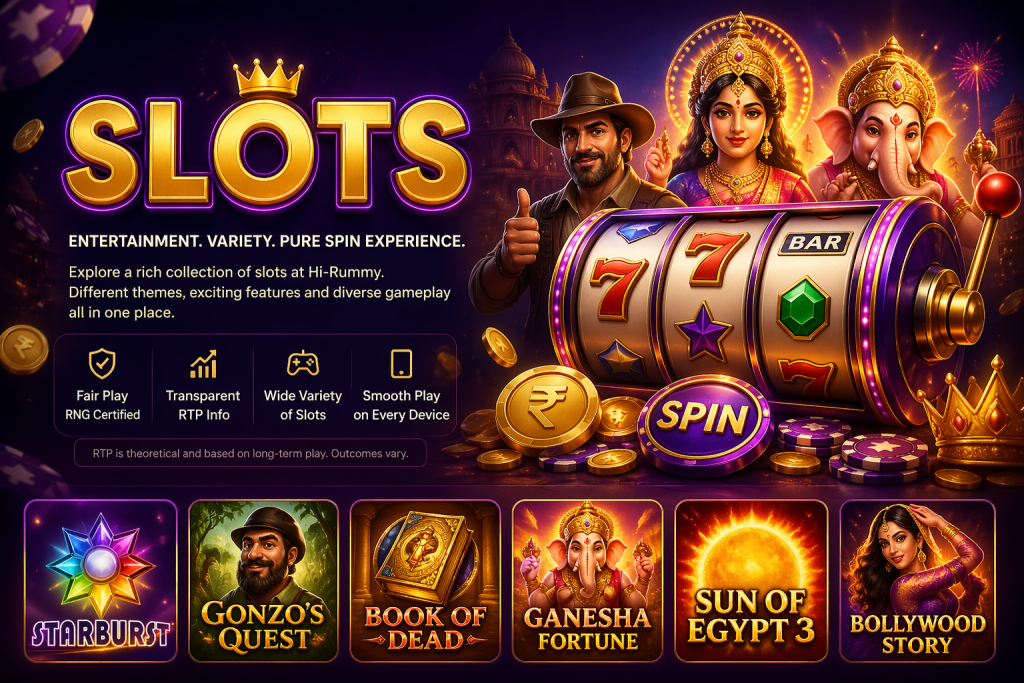
Some of the titles in this library are widely recognised international video slots. Others are culturally familiar games or local-format titles that may be interpreted differently by Indian users. That difference matters. A game like Starburst is usually read as a cleaner and lighter entry point because the visual structure is simple and the decision burden is low. Gonzo’s Quest and Dead or Alive are more often approached through feature identity and variance expectations. Titles such as Pearls of India, Bollywood Story, Indian Cash Catcher, Ganesha Fortune, Hanumanji, Teen Patti, Andar Bahar, and patti rummy create a different access route because thematic familiarity changes how quickly a player feels oriented within the interface.
That does not mean familiar themes reduce volatility or alter the RNG model. They do not. The independent outcome engine remains independent. What changes is user interpretation. A familiar theme can make a game feel easier to read, but visual familiarity should never be confused with mathematical softness. This distinction is important on slot pages because many users naturally over-read the presentation layer. An operator-level catalogue should reduce that confusion, not amplify it.
It is also useful to separate classic slot pacing from table-derived or card-adjacent formats. Teen Patti, Andar Bahar, and patti rummy do not sit in the same product logic as a conventional reel-based slot in the strictest sense, even if they appear inside a broader games shelf. Their rhythm, expectation model, and reading habits are different. That is why a structured table should identify not just the title, but the game format, session tone, and interpretation profile. This helps the page act like a usable interface rather than a decorative content block.
From a product perspective, the catalogue should support fast scanning. A user should be able to search by title, but also understand whether a game feels lighter, denser, more feature-led, or more theme-led. This is where a searchable table becomes practical. It does not predict outcomes and it does not recommend one result profile over another. Its role is to make the slot shelf legible. That is especially important on mobile, where cluttered tables tend to collapse into unreadable layouts unless the card mode is built carefully.
The list below therefore treats the hi-rummy slot shelf as a navigational layer. It is not a ranking, and it is not a claim about advantage. It is simply a clean product map that helps a user understand what kind of session structure each title is more likely to create from a reading and UX perspective.
| Title | Format | Session Tone | Feature Reading | Catalogue Role |
|---|---|---|---|---|
| Starburst | Video Slot | Light Entry | Clean reel reading, simple feature identity | Useful as an easy-access title in the shelf |
| Gonzo’s Quest | Video Slot | Balanced | Feature-led pacing with recognisable session rhythm | Strong mid-shelf feature title |
| Dead or Alive | Video Slot | Dense Variance | More variance-sensitive reading, less forgiving session feel | Higher-intensity catalogue title |
| Pearls of India | Themed Slot | Theme-Led | Cultural familiarity may improve interface orientation | Local-theme anchor title |
| Bollywood Story | Themed Slot | Theme-Led | Presentation-first reading with familiar cultural cues | Visual identity title |
| Sun of Egypt 3 | Video Slot | Feature Focus | Bonus-layer reading matters more than surface simplicity | Feature-driven library entry |
| 777 Fire Strike | Classic-Style Slot | Direct Read | Clear visual logic and lower interpretation friction | Classic shelf support |
| Divine Fortune | Jackpot Slot | Event-Led | Session attention often shifts toward feature possibility | High-attention title |
| Fruit Bonanza | Fruit Slot | Light Entry | Simple read, fast recognition, lower visual complexity | Quick-access classic title |
| Indian Cash Catcher | Themed Slot | Balanced | Theme familiarity with moderate feature attention | Regional relevance title |
| Book of Dead | Feature Slot | Dense Variance | Often read through bonus-trigger expectation | Recognised higher-intensity title |
| Ganesha Fortune | Themed Slot | Theme-Led | Familiar symbolic structure may simplify entry | Local shelf identity |
| Hanumanji | Themed Slot | Theme-Led | Strong theme recognition with easier first read | Regional thematic entry |
| Teen Patti | Card / Table-Style | Different Logic | Not a conventional reel slot reading model | Adjacent game format in the shelf |
| Andar Bahar | Card / Table-Style | Different Logic | Fast rule recognition, separate from slot reel structure | Parallel casual-format entry |
| patti rummy | Card / Rummy-Style | Different Logic | Should be read as a separate game logic family | Cross-category catalogue element |
RTP, RNG, Volatility, and Demo Mode in the Slot Environment
A slot page becomes more useful when it explains how to read game mechanics without turning that explanation into marketing. That is especially important on a platform where users may move between theme-led slots, classic reel formats, and card-adjacent games in a single session. The surface can change quickly, but the underlying interpretation rules should remain stable.
RTP should always be understood as a long-term statistical model. It is not a short-session promise and it is not a prediction layer. A player can interact with a title for a limited number of spins and see a result that sits far above or far below the published RTP model. That does not mean the model is broken. It means the session sample is small. Operator-level content should state this clearly because many low-quality pages use RTP language in a way that encourages the wrong expectation. A clean product page does the opposite. It keeps RTP in its correct frame.
RNG should be treated with the same discipline. The random number generator is independent and memoryless. Every outcome is calculated without regard to what happened before. There is no compensation cycle, no “due” state, and no hidden recovery path after a losing sequence. This matters even more in games that feel emotionally heavy because of their volatility profile. A high-variance title can create the impression that the system is “holding back” and then “releasing” value. In reality, what the player is feeling is uneven distribution, not mechanical memory.
Volatility is therefore best understood as a distribution model. It describes how value tends to be spread across outcomes over time. Lower-volatility titles are generally read as steadier because more of the experience is carried by smaller and more frequent events. Higher-volatility titles create a different reading pattern. Large parts of the session may feel quiet, then a more concentrated feature event may shape perception. That difference affects pacing, but it does not override the independence of each outcome.
Demo mode serves a separate purpose. It is useful for exploring reel behaviour, understanding symbol logic, checking feature presentation, and getting used to interface rhythm. It is not a forecasting tool. A user can learn how a game feels without treating that experience as a signal about future results in real play. The most responsible slot page makes that distinction explicit. It encourages exploration of mechanics, not confidence inflation.
This matters on hi-rummy because the slot shelf is mixed. Some titles are simple to scan. Some are more feature-led. Some are culturally familiar, which reduces friction but not variance. Others sit outside strict reel-slot logic altogether. A product page should help users compare those structures honestly. The chart below is built for that purpose. It does not show value, profit, or performance. It visualises how session reading becomes more complex as a user moves from lower-variance interpretation toward denser variance pressure and stronger feature concentration.
Volatility Reading Model
This chart shows how slot reading changes as variance and feature concentration become more pronounced. It does not indicate profit, edge, or expected success. It visualises interpretation load across different slot structures.
Comparing Slot Formats Without Overreading Outcomes
A slot page becomes more credible when it helps users compare formats without pretending that comparison can predict results. That is the balance an operator-style page should keep. A user can compare interface density, feature structure, cultural familiarity, pacing, and reading complexity, but none of those variables should be presented as a shortcut to outcome expectation. They help explain how a game is experienced. They do not function as a promise layer.
This distinction matters on hi-rummy because the shelf is mixed. It includes titles that are easy to scan, titles that are feature-led, and titles that belong more naturally to a card or local-table logic than to a reel-slot structure. A clean product page should not flatten those differences into a single generic label. It should show where a title sits in the catalogue and what kind of reading discipline it requires from the user.
A lower-friction title is not necessarily a lower-risk one in any financial or behavioural sense. It may simply be easier to read at the interface level. Likewise, a feature-dense title is not automatically “better” or “stronger.” It often just creates more interpretation load. Players tend to overreact most when a game produces long quiet stretches, concentrated bonus events, or visual designs that make patterns feel more intentional than they really are. The correct response from the page is not to amplify those emotions, but to reduce confusion.
That is why the final table below uses analytical language rather than promotional wording. It compares game formats through format logic, session reading, thematic orientation, and volatility interpretation pressure. It is not a ranking table and it is not a recommendation model. Its role is to help the slot shelf function as an understandable product layer.
In practical terms, this also improves usability. A mobile user should be able to open the page, scan the shelf, understand which titles are classic reel slots, which are feature-led video slots, and which belong to a different game family such as Teen Patti, Andar Bahar, or patti rummy. That helps reduce category confusion. It also keeps the page aligned with operator-level trust principles, because it explains structure without implying control over results.
The cleanest way to read the hi-rummy slot and adjacent-game shelf is therefore this: titles differ in rhythm, theme, complexity, and interface familiarity; RNG remains independent across real-play outcomes; RTP remains long-term; volatility remains a distribution characteristic; and demo remains an exploration tool rather than a prediction engine. Once those frames are clear, the catalogue becomes easier to navigate without turning the page into a marketing surface.
| Format Group | Included Titles | Session Reading | Volatility Interpretation | Product Use |
|---|---|---|---|---|
| Classic / Direct | Starburst, Fruit Bonanza, 777 Fire Strike | Usually easier to scan and enter quickly | Often read as lighter, though real outcomes still vary sharply | Useful for low-friction catalogue entry |
| Feature-Led Video Slots | Gonzo’s Quest, Sun of Egypt 3, Book of Dead, Dead or Alive, Divine Fortune | More event-driven, bonus-trigger awareness becomes central | Higher chance of overreading silence, streaks, or bonus timing | Best presented with clear mechanical framing |
| Indian Theme Shelf | Pearls of India, Bollywood Story, Indian Cash Catcher, Ganesha Fortune, Hanumanji | Familiar theme may reduce interface friction | Theme familiarity does not change RNG or RTP structure | Supports regional orientation and faster title recognition |
| Card / Adjacent Logic | Teen Patti, Andar Bahar, patti rummy | Should not be read through reel-slot logic alone | Different expectation model and different pace perception | Needs separate category clarity inside the shelf |
| Mixed Shelf Navigation | Entire hi-rummy game mix | Users need fast format recognition more than hype language | Clear labelling helps reduce interpretation errors | Improves mobile scanning and trust |