
Sun of Egypt 3 as a High-Volatility Slot Structure
Sun of Egypt 3 on Hi Rummy follows a slot architecture that is visually simple but structurally weighted toward feature-driven outcomes. The base game uses a standard reel system with symbol combinations resolving per spin, but a large portion of session attention is directed toward expanding symbols and free spin triggers. This shifts the perception of the game away from frequent small wins toward less frequent but more visible events.
Each spin is independent. The Egyptian theme, recurring symbols and visual continuity can suggest that the game is building toward a feature, but this is presentation, not progression. There is no internal counter that moves the player closer to a bonus. The system resolves every spin separately through RNG, without memory of previous outcomes.
RTP should be understood as a long-term distribution model. In high-volatility slots like Sun of Egypt 3, short sessions often deviate significantly from that model. A player may experience long sequences of base spins with minimal activity, followed by a feature event that carries most of the visible value. This is not a change in RTP; it is the way value is distributed across the session.
Volatility is central to how the game feels. In this case, volatility reflects concentration of value in expanding symbols and free spins. When these features are not active, the base game may feel quiet. When they trigger, the session becomes visually and structurally more intense. The player does not control when this shift happens. They only control stake size and pacing.
The expanding symbol mechanic is one of the defining elements. When triggered, a symbol can cover entire reels, increasing the chance of full-line combinations within that spin. This mechanic is resolved entirely within the spin where it appears. It does not carry forward into future spins, and it does not signal that another expansion is likely to follow.
Sun of Egypt 3 — Core Mechanics
Structural overview of how the slot behaves. Not a prediction model.
| Layer | Function | Player control | System behaviour |
|---|---|---|---|
| Reel Engine | Resolves symbol combinations per spin | Low | RNG, independent |
| Expanding Symbols | Can cover reels inside a single spin | None | Triggered per spin only |
| Free Spins | Main feature-driven outcome layer | None | Event-based, not scheduled |
| Volatility | Defines distribution of outcomes | Indirect | Fixed by design |
| Stake | Adjusts exposure per spin | High | Does not affect RNG |
This structure sets the correct expectation from the start. Sun of Egypt 3 is not a continuous story system. It is a high-volatility slot where most visible outcomes come from features rather than base spins. The player controls stake and pacing, but not when those features appear.
RNG, RTP and Expanding Symbol Logic
Sun of Egypt 3 looks simple on the surface — five reels, familiar symbols, a recognisable bonus trigger — but its internal behaviour is built around separation of layers. The visual layer highlights expanding symbols and free spins. The mathematical layer resolves each spin independently. Keeping these two ideas separate is what makes the page accurate.
RNG governs every spin. It determines symbol positions across reels and whether any feature condition is met. There is no accumulation logic behind the scenes. A sequence of empty spins does not increase the probability of a feature, and a sequence of wins does not reduce it. Each result is generated without memory of the previous one.
RTP remains a long-term property of the game. In high-volatility slots like Sun of Egypt 3, the distance between short-term experience and long-term expectation can be wide. A player may go through a session where free spins do not appear, or one where they appear early and carry most of the visible return. Both scenarios are consistent with the same RTP model.
Volatility explains why this happens. The game distributes a larger portion of its value through features rather than through frequent base-game wins. This creates sessions where the base layer feels relatively inactive, followed by moments where the expanding symbol mechanic or free spins dominate the outcome. The shift is structural, not reactive.
The expanding symbol mechanic is central. When a symbol expands, it fills an entire reel within that single spin. This increases the chance of forming full-line combinations during that spin only. The key point is isolation: the expansion does not carry into the next spin, and it does not signal that another expansion is likely. It is a contained event.
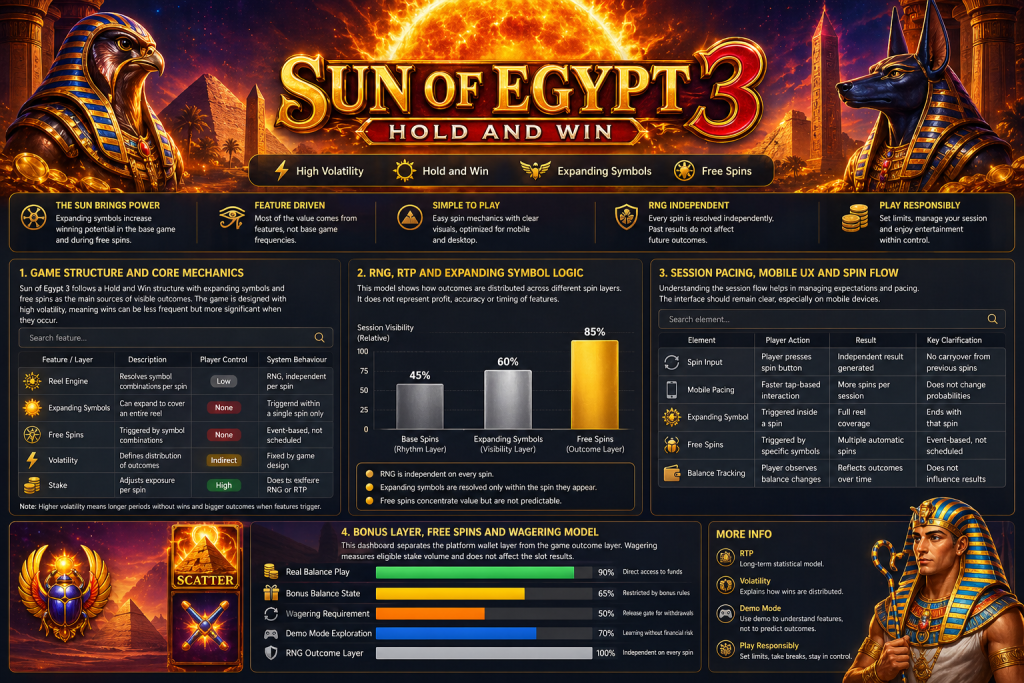
The chart below shows how attention and value are distributed between base spins, expansion events and free spins. It does not represent profit or expected gain. It simply maps how the game expresses outcomes across different layers.
Base Spins vs Expanding Symbols vs Free Spins
This model shows how visibility and value are distributed across spin layers. It does not indicate higher returns or timing of features.
The important point is balance between visibility and independence. Expanding symbols and free spins make the session feel dynamic, but they do not introduce predictability. The game does not “move toward” a feature. It simply resolves each spin, and sometimes that resolution includes a higher-visibility event.
This is where many slot pages go wrong — they describe features as if they are building. In a properly structured explanation, features are presented as outcomes, not as progress.
Session Pacing, Mobile UX and Spin Flow
Sun of Egypt 3 becomes much clearer when the session is treated as a sequence of controlled inputs rather than a stream of outcomes. The player sets the stake, initiates the spin and observes the result. Everything else — symbol placement, expansion, feature triggering — is resolved by the engine. The interface should make that separation visible, especially on mobile where pacing can easily drift.
Mobile sessions tend to be faster. Shorter animations, closer controls and continuous tapping can compress time between spins. This does not change the game, but it changes how variance is experienced. A sequence that would feel gradual on desktop can feel abrupt on mobile simply because more spins are completed in less time. A stable layout helps counter that by keeping key elements fixed: balance, stake and spin state should not shift position or compete with animations.
Spin flow in Sun of Egypt 3 is straightforward. There is no intermediate decision layer as in table games. The only variation comes from what the spin produces. That makes clarity more important than density. The player needs to understand when a spin starts, when it ends and whether a feature is active. Overloading the screen with effects can blur that boundary and create confusion about what actually happened.
Symbols follow a fixed logic. Standard symbols form combinations. Special symbols may expand or trigger features. The important detail is that all of this happens within the same spin cycle. There is no persistence of symbol states between spins. A near expansion does not increase the chance of a full expansion on the next spin. The system does not track “almost” events.
The table below keeps these ideas in a clean format. It describes how session elements behave without turning them into signals or predictions.
Session Flow and UX Structure
Describes how the player interacts with the slot across devices. Not a behavioural or outcome model.
| Element | Player action | Result | Clarification |
|---|---|---|---|
| Spin input | Player initiates spin | Independent result generated | No carryover from previous spins |
| Mobile pacing | Faster tap-based interaction | More spins per session | Does not change probabilities |
| Expanding symbol | Triggered inside a spin | Full reel coverage | Ends with that spin |
| Free spins | Triggered by symbol combination | Multiple automatic spins | Event-based, not scheduled |
| Balance tracking | Player observes changes | Reflects outcomes over time | Does not influence results |
Bonus Layer, Free Spins and Wagering
Sun of Egypt 3 often draws attention through its free spins feature. This is where most of the visible action takes place. During free spins, the same underlying logic applies — each spin is still independent — but the structure allows multiple spins to occur without additional input. This changes how the session feels, not how the math works.
Free spins are triggered by specific symbol combinations. They are not queued or scheduled behind the scenes. A long gap without a feature does not increase the chance of triggering one, and a recent feature does not reduce it. The system does not manage expectation; it simply resolves conditions.
When a bonus is active at the platform level, wagering rules can apply. In slots, contribution is often straightforward, but the player should still treat wagering as a measurement layer. It tracks how much eligible stake volume has been completed. It does not interact with symbol behaviour, expansion frequency or feature triggers.
Demo mode remains a separate tool. It allows the player to see how expanding symbols behave, how free spins are presented and how pacing works on mobile or desktop. It does not provide insight into when features will appear in real play. The independence of spins applies equally in both modes.
The final graph shows how the wallet layer and game layer interact. It does not represent value or performance. It shows separation.
Sun of Egypt 3 works best when the player understands this separation. The slot delivers a feature-driven experience. The RNG defines outcomes independently. RTP describes long-term distribution. Volatility explains how those outcomes are spaced. The platform layer manages access to funds, not the behaviour of the reels.