
Patti Rummy on Hi Rummy: Game Structure and Player Flow
Patti Rummy on Hi Rummy combines elements of traditional rummy logic with a simplified, session-based digital structure. The player enters a round or table environment where the objective is to form valid combinations of cards according to the rules of the game. While the experience feels strategic, the initial card distribution is still controlled by the system.
The round begins with cards being dealt to each participant. This distribution phase is fully handled by RNG and remains independent for every round. No previous hand influences the cards received in the next one. From the moment the hand is dealt, the player transitions into the decision layer, where choices define how the round progresses.
The gameplay loop includes drawing a card, discarding a card and arranging combinations such as sequences or sets. These actions continue until a valid hand is formed or the round is otherwise resolved. The player’s role is to manage information, evaluate card value and decide which combinations to build toward. This creates a strong perception of control within the round.
However, this control exists only after the initial distribution. The quality of the starting hand is not influenced by timing, session length or previous outcomes. RNG ensures that each deal begins from a neutral state. Even if a player experiences several weak or strong starting hands in a row, this does not reflect a pattern or system adjustment.
RTP in Patti Rummy is not experienced in the same way as in spin-based games. Instead, the outcome depends on how rounds resolve over time within the rules of the game. Short sessions may feel inconsistent because card distribution and player decisions interact in different ways each time. This is part of the system, not a deviation from it.
Volatility appears through how quickly a player can complete valid combinations. Some hands may allow fast progression, while others require more steps and adjustments. This affects pacing and balance movement, but it does not change the underlying distribution of cards.
The key structure is clear: the system deals the cards, and the player manages the hand. Decisions influence how the round evolves, but they do not change the initial conditions created by the game engine.
Patti Rummy Round Structure
| Stage | Visibility | Player Control | Role |
|---|---|---|---|
| Card Distribution | Partial | None | RNG |
| Draw Phase | Full | Direct | Player Action |
| Discard Phase | Full | Direct | Player Action |
| Combination Building | Full | Direct | Strategy Layer |
| Resolution | Full | None | Outcome |
RNG, Card Distribution and Decision Logic in Patti Rummy
Patti Rummy on Hi Rummy operates through a combination of independent card distribution and player-driven decision-making. The initial deal defines the starting position of the round, while the player’s actions determine how that position evolves. These two layers are connected in the experience but remain separate in logic.
The card distribution phase is fully controlled by RNG. Each round begins with a new and independent deal. The system does not remember previous hands, adjust card quality or respond to player behaviour. A strong or weak starting hand is simply part of the distribution model. Even if similar hands appear consecutively, this does not indicate a pattern or system response.
Once the cards are dealt, the player enters the decision layer. Drawing and discarding cards creates a flow where the hand gradually changes shape. The player evaluates possible sequences, sets and combinations, deciding which direction to follow. This creates a sense of control, but it is important to understand its limits. Decisions influence how the hand is managed, not how cards enter the system.
Probability in Patti Rummy is not experienced as a fixed percentage per action. Instead, it emerges from the availability of useful cards over time. Some rounds provide more immediate opportunities for combination building, while others require longer adjustment. This variation affects pacing but does not change the fairness of the system.
Volatility appears through the time required to reach a valid hand. A round that resolves quickly may feel more efficient, while a longer round may feel more demanding. These differences come from card availability and decision paths, not from changes in the underlying distribution.
The core understanding is that the system defines the starting conditions, and the player navigates them. The interaction creates the experience, but the foundation remains independent and consistent across all rounds.
Card Distribution vs Player Decision Flow
This chart separates the independent card deal from the player-driven hand development process.
Bonus Layer, Wagering and Wallet Rules in Patti Rummy
Patti Rummy on Hi Rummy can operate through different wallet states depending on whether the player is using cash balance, bonus funds or another promotional balance type. This distinction matters because the game layer and the account layer do not perform the same function. The game layer controls card distribution, draw decisions, discard choices and hand resolution. The wallet layer controls how funds are classified, restricted and released.
Bonus funds do not change the card engine. They do not improve the starting hand, increase access to useful cards or reduce the difficulty of completing combinations. When a bonus is active, Patti Rummy still uses the same distribution logic. What changes is the rule set around the balance after each eligible action.
Wagering should be understood as a release gate. It measures eligible staking volume under the platform’s conditions. It is not a mission inside the game and it does not reward specific card decisions. A player may build a strong hand or make careful discards, but wagering progress is still determined by eligible stake activity and the rules attached to the wallet state.
This separation is especially important for rummy-style games because the player has more visible decisions than in a simple spin game. The presence of decisions can make the experience feel more controllable, but that control does not extend to bonus mechanics. Promo codes, welcome offers or cashback structures belong to the account layer, not the card layer.
A clean explanation helps prevent confusion. Patti Rummy gameplay remains about managing the hand after the deal. Bonus logic remains about tracking balance status, eligibility and release conditions.
Patti Rummy Wallet and Wagering Layer
| Rule Area | What It Controls | Effect on Patti Rummy |
|---|---|---|
| Bonus Funds | Creates a separate promotional balance state. | No effect on card distribution or valid combinations. |
| Wagering | Tracks eligible staking volume under bonus terms. | Does not reward specific draw or discard choices. |
| Promo Code | Activates account-level promotional conditions. | Does not change RNG or card availability. |
| Maximum Bet Rule | Restricts stake size while bonus terms are active. | Controls compliance, not gameplay logic. |
| Withdrawal Release | Defines when funds become eligible for cashout. | External to hand building and round resolution. |
Mobile UX, Session Rhythm and Player Control in Patti Rummy
Patti Rummy on Hi Rummy is designed to work within short, repeatable sessions where the player can enter, play and exit without needing to manage a complex interface. On mobile, this becomes even more important. The player must be able to read the hand, understand available actions and react quickly without losing context.
The mobile layout typically focuses on three key elements: the current hand, the draw/discard options and the visible table state. These need to remain clear even during longer rounds where multiple decisions are made. A clean interface reduces friction and allows the player to focus on managing combinations rather than navigating the UI.
Session rhythm in Patti Rummy depends on how quickly a valid hand can be formed. Some rounds progress smoothly with early useful cards, while others require more adjustment and time. This creates variation in pacing, but it does not indicate a shift in probability. Each round still begins with an independent deal and develops through player decisions.
Player control exists within the decision layer. Choosing which card to draw, which to discard and how to build combinations affects the path of the round. However, this control does not extend to the arrival of new cards. The system determines card distribution independently, and no decision can change that process.
Short sessions can feel inconsistent because the interaction between distribution and decision-making varies each time. A player may experience several rounds with difficult starting hands or several with strong progression. These sequences do not form a pattern and do not influence future rounds.
Responsible play is based on managing time and stake rather than trying to influence outcomes. Because Patti Rummy includes visible decisions, it can feel more controllable than other formats. However, the same principle applies: outcomes begin with independent distribution, and the player navigates within those conditions.
Patti Rummy Mobile Session Model
This dashboard describes interaction behaviour and session dynamics, not prediction or expected results.
Hand Development, Information Flow and Perception in Patti Rummy
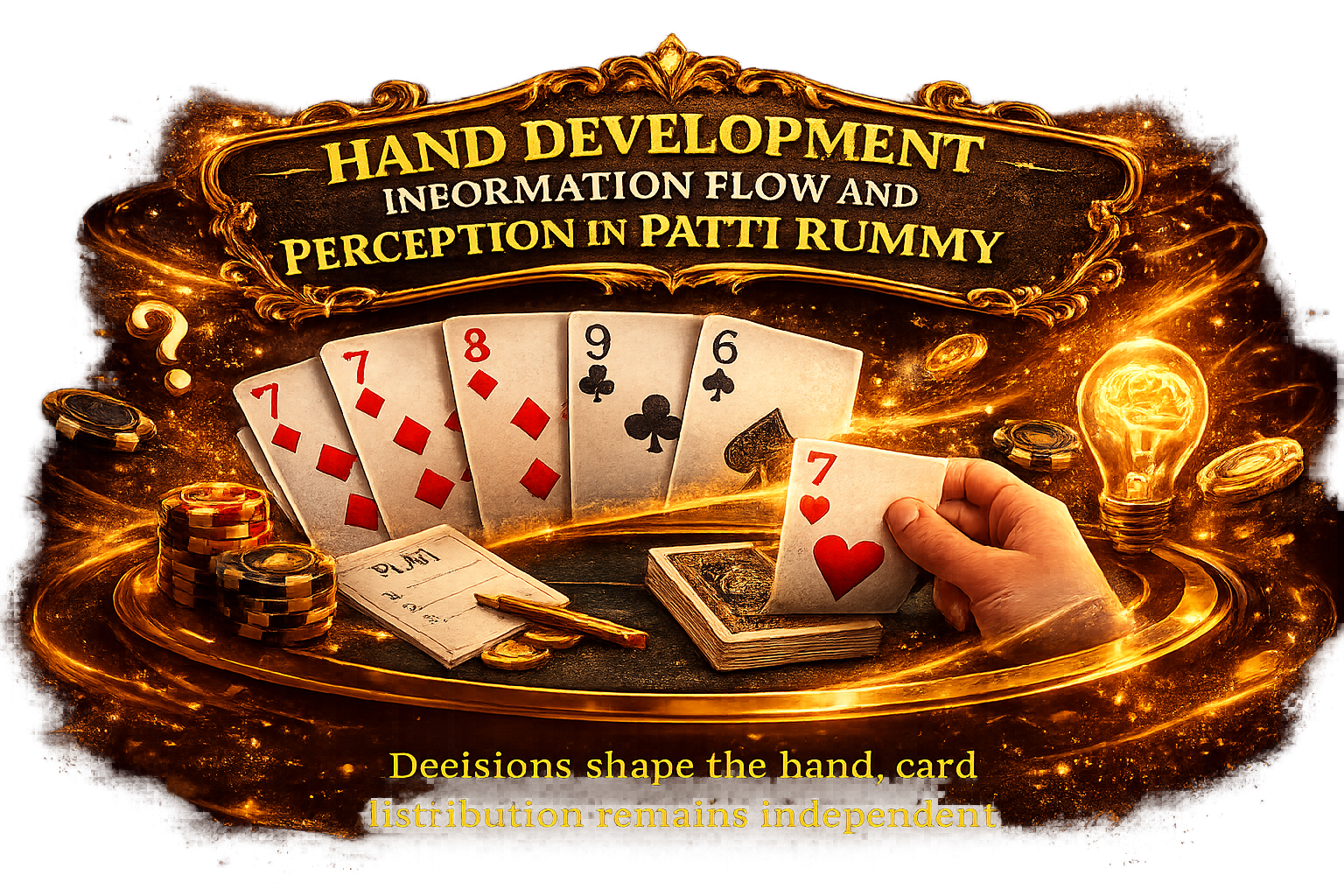
Patti Rummy creates a strong sense that the player is gradually shaping the outcome through a sequence of decisions. This comes from how information is revealed during the round. Cards are drawn one by one, combinations start to form, and each action appears to move the hand closer to completion. The process feels progressive and reactive, which can make it seem as if the system is responding to the player’s choices.
In reality, the structure is more stable. The initial deal defines the starting position, and every new card drawn is generated independently. The player is working within a moving window of information, not influencing the source of that information. Decisions affect how the hand is managed, but not which cards will appear next.
This distinction becomes important during longer rounds. When a player is close to completing a valid combination, it may feel as though the system is “holding back” or “delaying” the final card. In other cases, a useful card may appear quickly, reinforcing the idea that good decisions are being rewarded. Both interpretations come from perception rather than system behaviour. The game does not delay or accelerate outcomes based on player state.
Information flow in Patti Rummy is incremental. Each draw changes the visible possibilities of the hand. The player continuously re-evaluates the situation based on new input. This creates a dynamic experience where strategy feels central. However, the randomness of incoming cards remains constant throughout the round.
Another common misinterpretation comes from short-term patterns. A player may experience several rounds where combinations are difficult to complete, followed by a round where everything aligns quickly. This can feel like a shift in game behaviour, but it is simply variation within independent events. The system does not adjust difficulty or card quality over time.
Understanding this structure helps maintain clarity. Patti Rummy is a game where decisions matter within the boundaries of available information. The player influences how efficiently a hand is managed, but not how the underlying card distribution operates.