
Starburst Slot Overview for Hi Rummy India
Starburst is a simple slot by structure, but that simplicity needs clear product framing on a Hi Rummy page for Indian users. The game does not rely on complex missions, bonus buying or layered progression. Its core experience is built around short spins, expanding wilds and a clean visual rhythm that works well on mobile screens.
For Hi Rummy, the important point is not to present Starburst as a shortcut to outcomes. It should be described as a recognisable slot format with transparent mechanics: fixed reels, simple paylines, random spin resolution and a feature layer that appears only when the RNG produces the required symbol position. The game can feel fast, but session speed does not change RTP. RTP remains a long-term mathematical model, not a promise for one short session.
The slot’s appeal comes from clarity. Players can understand the screen quickly, see how wilds expand, and follow the outcome without needing a long rules explanation. That makes Starburst suitable for users who prefer low-friction slot sessions, but it also means the page should explain boundaries clearly. A simple game is not a predictable game. Every spin is independent, and the system does not remember previous results or compensate after losing rounds.
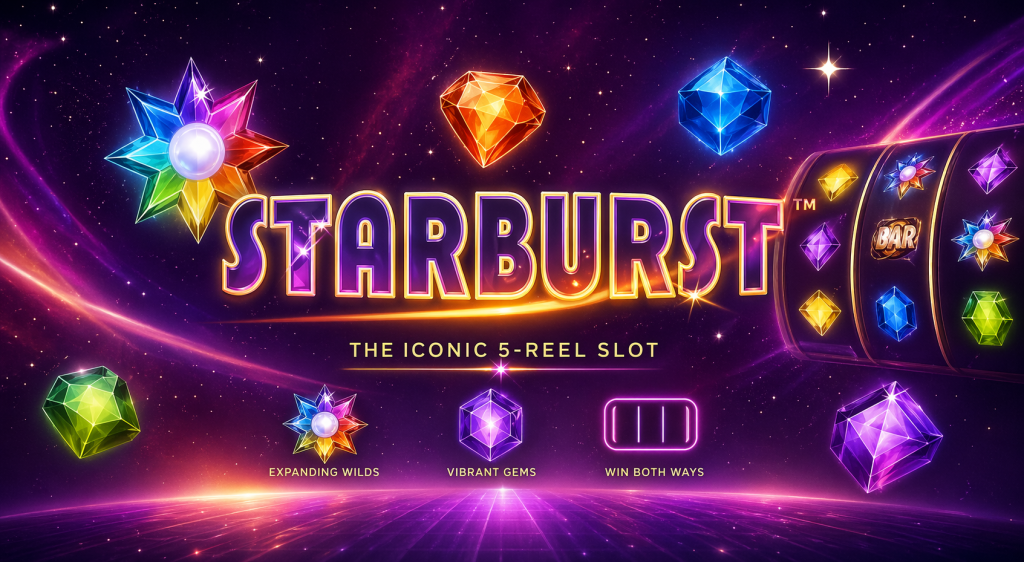
On a casino platform page, Starburst should sit in the slot catalogue as a lightweight, visually familiar title. It is not a strategy game, and it should not be framed like one. The player can choose stake size, session length and whether to use demo mode, but the result layer remains controlled by RNG. The value of the page is therefore operational: explain the mechanic, separate entertainment from expectation, and make the rules understandable before play.
Starburst Product Reading Layer
Search or sort the table to compare the main slot components without turning mechanics into outcome promises.
| Layer | Player Sees | Operational Meaning | Clarity | Responsible Note |
|---|---|---|---|---|
| Base reels | Clean five-reel layout with quick visual reading | Low-friction slot format suitable for short mobile sessions | 86 | Easy to read does not mean easy to predict |
| Expanding wild | Wild symbol expands across the reel when triggered | Feature creates visible round variation inside the spin result | 78 | Feature appearance remains RNG-based |
| RTP model | Published percentage describes long-run game maths | Used for product transparency, not session forecasting | 72 | Short sessions do not reproduce RTP |
| RNG spin | Each spin resolves independently | Outcome layer is separate from login, wallet and bonus state | 91 | No memory, correction or compensation cycle |
| Volatility | Results may feel smooth or uneven across sessions | Describes distribution of values, not profitability | 69 | Session pacing should be controlled by the user |
RTP, RNG and Volatility Structure
Starburst should be explained through three separate layers: RTP, RNG and volatility. These terms are often placed together, but they do not describe the same thing. RTP is the long-term mathematical model of the game. RNG is the independent system that resolves each spin. Volatility describes how values may be distributed across play, including the possibility of quiet stretches or sharper result changes.
For Indian players using Hi Rummy, this separation matters because it prevents the slot from being misunderstood as a pattern-based product. A session may feel active because spins are fast and the expanding wild mechanic is visually clear, but that does not mean the game is moving toward a correction. The next spin is not influenced by the previous spin. A sequence of non-feature spins does not create a stored feature expectation inside the game system.
RTP also needs careful framing. It is not a session target and it is not a balance forecast. It describes the game model across a very large volume of play. A short mobile session on Hi Rummy can sit far above or far below that model because the player is only seeing a small sample. This is why RTP should be treated as a transparency figure, not as a promise of what will happen in one sitting.
Volatility is equally important. It does not mean profit potential, and it should not be written as a signal of better or worse value. It describes the shape of distribution: how often smaller events may appear, how uneven the session may feel, and how the slot rhythm can change when feature symbols appear or do not appear. In Starburst, the clean interface can make the game feel gentle, but the underlying spin result still belongs to the same independent RNG layer.
Spin Logic Separation: RTP, RNG and Volatility
The chart separates the main mathematical and operational layers behind Starburst. Higher bars show how visible each layer is to player understanding, not stronger outcomes or expected returns.
The practical reading is simple: Starburst can be fast and visually clear, but the game does not become predictable because of that clarity. The expanding wild mechanic gives the session a recognisable moment, yet it does not create a memory trail. The game does not “owe” a feature after quiet spins, and it does not reduce feature probability after a visible result.
This distinction is important for a Hi Rummy India page because many users approach slots from a mobile-first environment where sessions are short and results are checked quickly. A short session can feel intense because many spins happen in a limited time, but the sample remains small. Responsible product writing should keep that point visible without making the page negative or overly technical.
Bonus, Demo and Session Layer
Starburst does not rely on complex bonus mechanics, but it still interacts with the platform-level systems on Hi Rummy. That interaction happens outside the game logic itself. The slot runs on RNG, while bonuses, wagering rules and demo mode exist as a separate operational layer. Keeping that separation clear is essential.
Bonus funds, if activated, change the wallet state, not the game behaviour. The spin result remains independent. The system may restrict eligible games, cap stake size or define wagering volume, but none of those rules alter how symbols land on the reels. This distinction removes a common misunderstanding: bonuses do not make the game “pay differently.” They define how results are processed, not how they are generated.
Wagering should be understood as a release mechanism. It measures eligible staking volume before funds can move out of the bonus state. It is not a mission or a progression path. The player is not “unlocking outcomes,” only completing a defined requirement tied to the wallet system. In Starburst, where spins are fast and repetitive, this can create a perception of steady movement, but that movement belongs to wagering progress, not to the game logic.
Demo mode sits even further away from outcome expectations. It is useful for understanding how expanding wilds behave, how the reels look on mobile, and how quickly the session moves. It does not provide predictive value. A demo session cannot indicate what will happen in real play because each environment resolves spins independently.
Platform Layer vs Game Layer
This table separates what belongs to the Hi Rummy platform and what belongs to Starburst itself.
| Layer | Belongs To | Function | Impact on Outcome |
|---|---|---|---|
| Bonus funds | Platform | Changes wallet state and usage conditions | No effect on RNG results |
| Wagering | Platform | Tracks eligible staking volume | No effect on symbol generation |
| Demo mode | Separate environment | Explores mechanics without real balance | No predictive value for real play |
| Spin result | Game | Determined by RNG at the moment of spin | Fully independent each round |
| Expanding wild | Game | Feature triggered by symbol position | Occurs only when RNG conditions match |
The key takeaway for this layer is structural clarity. Starburst remains a self-contained RNG-driven slot, while Hi Rummy provides the surrounding environment: wallet, bonuses, limits and access. Mixing these layers in explanation creates confusion. Separating them allows the player to understand what can be controlled and what cannot.
Mobile Experience, Session Rhythm and Responsible Fit
Starburst fits naturally into a mobile-first environment like Hi Rummy. The interface is compact, symbols are easy to distinguish, and the expanding wild mechanic is visually clear even on smaller screens. This reduces friction. The player does not need to learn multiple layers of rules or track complex feature states. One spin leads directly to the next without interruption.
That simplicity affects how sessions feel. Spins are quick, transitions are smooth, and the visual feedback loop is short. This can create a perception of steady movement, especially when playing in short bursts throughout the day. However, this pacing belongs to the interface, not to the outcome logic. Faster spins do not change how results are generated. The RNG layer remains identical regardless of whether the session is fast or slow.
On mobile, session control becomes more important. Because Starburst does not slow the player down with complex decisions, it is easy to extend play without noticing time passing. That is not a property of the game mechanics themselves, but of the UX design. A clear product page should acknowledge this and position session length as a user-controlled variable. The player defines when the session starts and ends, not the game.
Another important distinction is between perceived rhythm and mathematical distribution. A player may feel that the session is “active” because spins are happening quickly and small events appear regularly. That feeling does not indicate that the game is moving toward a larger result. Volatility describes how values may appear over time, but it does not create direction. There is no progression toward a specific outcome.
Session Perception vs System Reality
These bands compare how a Starburst session may feel to a player versus how the system actually behaves. The chart does not describe outcomes, only perception differences.
The final positioning of Starburst on Hi Rummy is therefore straightforward. It is a clean, accessible slot designed for quick interaction and visual clarity. It does not contain hidden systems, adaptive behaviour or progression logic. The player interacts with a transparent structure: spin, result, repeat.
Responsible use comes from understanding that structure. The player controls session length, stake size and whether to engage with bonus conditions. The system controls the outcome generation through RNG. Keeping these roles separate is what allows the game to be understood clearly, without inflated expectations or misleading interpretations.