Gonzo’s Quest Overview for Hi Rummy India
Gonzo’s Quest is structurally different from Starburst, even though both sit in the same slot category. The key difference is the avalanche mechanic. Instead of spinning reels that reset fully each round, symbols fall into place and are replaced after winning combinations. This creates a chain effect inside a single spin, where multiple results can occur without a new spin being triggered.
On a Hi Rummy page, this mechanic should not be framed as a multiplier of outcomes, but as a structural variation of how one spin unfolds. The player is not triggering extra chances. The game is resolving one RNG event across multiple visual steps. This is important because avalanche slots can feel more dynamic than standard reel slots, which may lead to incorrect assumptions about probability or outcome flow.
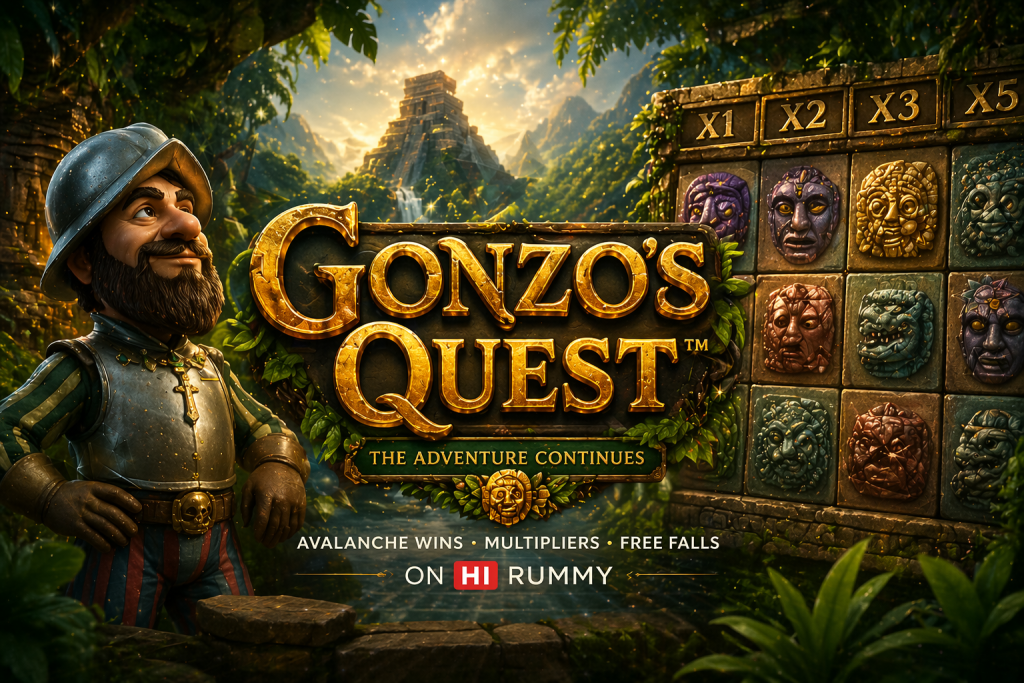
The Gonzo theme adds a narrative layer, but it does not influence gameplay logic. The character, environment and sound design exist as presentation. The actual system remains mathematical: RNG determines symbol placement, and the avalanche sequence simply reveals how that result is expressed. There is no adaptive behaviour, no memory, and no session-based adjustment.
From a product perspective, Gonzo’s Quest is positioned as a more visually active slot compared to simpler formats. It introduces a sense of continuity inside each round. However, that continuity is visual, not predictive. Each spin begins as an independent event, and the avalanche mechanic does not carry value from one spin to the next.
| Mechanic | Player Sees | System Role | Key Clarification |
|---|---|---|---|
| Avalanche | Symbols fall and replace after wins | Extends a single RNG outcome visually | Not multiple spins, one resolved event |
| Multiplier | Value increases during cascades | Applies inside one round | Resets next spin, no carryover |
| RNG | Each spin outcome is independent | Controls symbol placement | No memory or pattern |
| RTP | Displayed return percentage | Long-term mathematical model | Short sessions vary widely |
Avalanche Mechanic, RTP and RNG Structure
The avalanche system in Gonzo’s Quest changes how a single spin is experienced, but it does not change how the result is generated. This distinction matters. When symbols fall and new ones replace them, it may look like multiple independent events. In reality, the system is resolving one RNG outcome step by step. The visual layering creates continuity, but the mathematical layer remains fixed at the moment the spin begins.
This is where misunderstanding often appears. A player may feel that consecutive cascades increase the chance of further cascades. That is not how the system operates. The sequence is already defined within the outcome of the spin. The game is not reacting to previous cascades in real time. It is revealing a pre-determined structure based on the RNG result.
RTP must be placed in the same frame. It describes the total model of the game over extended play, not how often avalanches or multipliers will appear in a short session. A short Hi Rummy session may contain several cascades or none at all. That variation is expected because the sample size is small. RTP does not smooth that experience at the session level.
Volatility in Gonzo’s Quest is closely tied to how these avalanche sequences unfold. Instead of thinking in terms of “big or small wins,” it is more accurate to describe how value can cluster within a single spin. One spin may resolve immediately, while another may extend through multiple cascades. That difference creates uneven session pacing, but not directional behaviour.
Avalanche Flow vs Independent Spin Resolution
The chart shows how a single spin unfolds into multiple visual steps while remaining one RNG-driven event. Higher bars represent visual intensity, not probability or expected return.
The practical takeaway is that Gonzo’s Quest feels more dynamic because each spin can unfold in stages, but that dynamic feeling should not be interpreted as changing odds. The system is consistent: one spin, one independent result, visually expanded through cascades.
Bonus, Free Falls and Demo Layer
Gonzo’s Quest introduces an additional feature layer through Free Falls, but this should still be framed within the same separation model used across the platform. The feature does not alter how outcomes are generated. It changes how one spin sequence behaves once the feature condition is met.
Free Falls are triggered when specific symbols appear in the correct positions. Once activated, the avalanche mechanic continues under a modified multiplier structure. This creates longer chains within a single feature session, but the underlying logic remains unchanged. The RNG determines when the feature starts, and each cascade inside it is still part of the same independent resolution process.
From a Hi Rummy perspective, it is important to separate this from bonus systems. Free Falls belong to the game. Bonus funds, wagering requirements and promotional conditions belong to the platform. They may interact in terms of eligibility, but they do not merge into a single system. The player may be using bonus funds while triggering Free Falls, but the outcome generation is not influenced by that state.
Wagering again should be understood as a measurement layer. Gonzo’s Quest, with its cascade structure, can create longer spin sequences, which may give the impression of faster wagering progress. However, that progress depends on eligible staking volume, not on how visually long a spin appears. A long avalanche chain does not count as multiple bets unless separate wagers are placed.
Demo mode is particularly useful in this slot because it allows the player to observe how cascades and multipliers behave without attaching value to the result. It helps to understand pacing and structure. But it does not provide predictive insight. A demo session cannot indicate how often Free Falls will trigger in real play.
| Layer | Type | Function | Clarification |
|---|---|---|---|
| Free Falls | Game Feature | Extends avalanche sequence with higher multipliers | Triggered by RNG, not player timing |
| Multiplier | Game Logic | Increases within cascade chains | Resets after spin ends |
| Bonus Funds | Platform | Controls how balance is used | No effect on game outcome |
| Wagering | Platform | Tracks eligible bet volume | Not linked to cascade length |
| Demo Mode | Separate | Explores mechanics safely | No predictive value |
The key point is consistency. Gonzo’s Quest may feel more layered than simpler slots, but its structure is still transparent when separated correctly: game logic handles outcomes, platform logic handles conditions. Keeping those layers distinct prevents the player from attributing meaning to features that do not influence probability.
Mobile Flow, Session Rhythm and Responsible Fit
Gonzo’s Quest behaves differently on mobile compared to simpler slots because the avalanche mechanic creates longer visual sequences within a single interaction. Instead of a clear stop–start cycle between spins, the player sees a continuous flow: symbols fall, resolve, and are replaced multiple times before the spin fully ends. This gives the session a more “connected” feeling.
On Hi Rummy, where most sessions happen on mobile devices, this continuity can change how time is perceived. A single spin may last longer, but fewer spins are initiated overall compared to faster reel-based slots. The session does not necessarily move quicker — it feels denser. That distinction matters because perception can influence how long a player stays engaged.
From a system perspective, nothing changes. Each spin still begins with an independent RNG outcome. The avalanche sequence does not introduce additional chances or modify probability mid-spin. It simply reveals more of the outcome before resetting. When the spin ends, the system returns to a neutral state. There is no carryover, no stored multiplier, and no retained pattern.
Session rhythm in Gonzo’s Quest is therefore uneven by design. Some spins resolve immediately, while others extend through multiple cascades. This creates variation in pacing, which may feel like progression, but it is not directional. The system is not moving toward a result. It is resolving independent events that happen to look continuous.
Perceived Flow vs System Reset
This model compares how Gonzo’s Quest may feel during cascades versus how the system actually resets after each spin.