
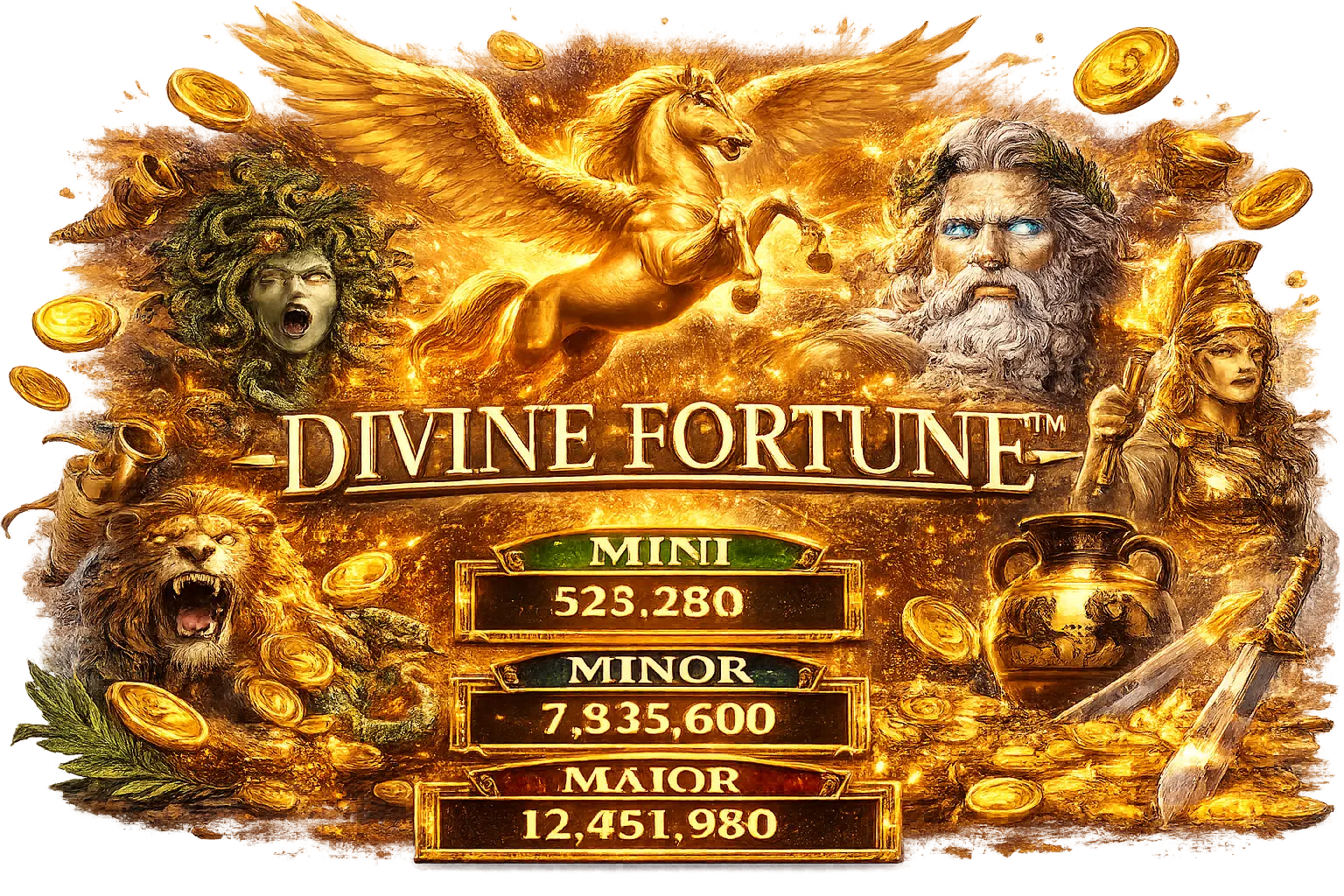
Divine Fortune as a Progressive Slot System
Divine Fortune on Hi Rummy is built around a layered structure where the base slot engine operates independently, while a separate progressive jackpot system runs in parallel. The game presents a mythological Greek theme, but the core mechanics are defined by how standard spins interact with bonus triggers and jackpot conditions.
Each spin is resolved independently through RNG. The presence of scatter symbols, near-bonus outcomes or visual patterns does not create progression toward a feature. This is particularly important in jackpot-based slots, where players often assume that the system is “moving toward” a payout. In reality, every spin starts from the same state, regardless of what happened before.
The progressive jackpot layer is separate from the reel logic. It accumulates value over time across multiple players and sessions, but the trigger condition is still random. The jackpot does not become “due” because it has not been hit recently. Its size reflects accumulation, not probability.
RTP in Divine Fortune includes both base game returns and contributions from jackpot events. Because jackpots are rare but high-impact, short sessions can feel disconnected from the theoretical return. A player may not encounter any jackpot event, or may see a significant portion of RTP expressed through a single feature. This is consistent with the design.
Volatility is influenced by this structure. The base game provides continuity with smaller outcomes, while free spins and jackpot triggers introduce higher-impact moments. The balance between these layers defines how the session feels. The player cannot control when jackpots or features appear; they can only control stake and pacing.
The key to understanding Divine Fortune is separation of layers. The reels determine symbol outcomes. The feature system determines when free spins activate. The jackpot system operates alongside both, with its own independent trigger logic.
Divine Fortune — Core Structure
Reels, features and jackpot layer explained. Not a prediction model.
| Layer | Function | Player control | System behaviour |
|---|---|---|---|
| Reel Engine | Resolves symbol combinations | Low | RNG, independent |
| Free Spins | Feature-based spin sequence | None | Triggered randomly |
| Jackpots | Progressive prize layer | None | Separate trigger logic |
| Volatility | Distribution of outcomes | Indirect | Feature + jackpot weighted |
| Stake | Adjusts exposure | High | No effect on RNG |
RNG, RTP and Progressive Jackpot Logic
Divine Fortune is often read as a “jackpot slot,” but the more accurate way to describe it is a standard reel system with an attached progressive layer. The reels determine symbol outcomes. The jackpot system exists alongside them, triggered under its own conditions. These layers are connected in presentation, but not in behaviour.
RNG governs both base spins and feature triggers. Each spin is independent. The appearance of wilds, scatters or near-feature combinations does not move the game closer to a jackpot. There is no internal tracking of “almost” events. This is particularly important with progressive slots, where visual cues can suggest momentum. In practice, the system does not build toward a payout.
RTP includes contributions from multiple sources: base game wins, free spins and jackpot events. Because jackpots represent a large but infrequent portion of total return, short sessions may not reflect this distribution at all. A player may complete many spins without interacting with the jackpot layer. This does not indicate a deviation from RTP. It reflects how the model distributes value over time.
The progressive jackpot itself accumulates independently of individual sessions. Each eligible spin contributes a small portion to the jackpot pool. This increases the visible jackpot value, but does not change the probability of triggering it. The chance remains defined by the game rules, not by the size of the pool or how long it has been since the last win.
Volatility in Divine Fortune is influenced by both feature rounds and jackpots. Free spins provide structured bursts of activity, while jackpots introduce rare, high-impact events. The combination creates a mixed volatility profile: relatively steady base gameplay with occasional spikes of higher visibility.
The graph below shows how the session is divided between base spins, feature rounds and jackpot events. It is not a performance model. It reflects how attention and value are distributed across layers.
Base Game vs Free Spins vs Jackpot Layer
This model shows how visibility shifts between regular spins, feature rounds and jackpot events. It does not represent expected return.
The key relationship here is independence. Base spins, features and jackpots all contribute to the overall structure, but none of them influence when the others occur. The jackpot does not become more likely because of previous spins, and features do not act as a pathway toward it.
This separation defines how Divine Fortune should be understood and presented.
Session Pacing, Mobile UX and Spin Behaviour
Divine Fortune feels different from many slots not because of its mechanics, but because of how its layers are perceived during a session. The base game, free spins and jackpot layer all exist at the same time, yet they do not operate at the same frequency. The interface has to make that clear, especially on mobile where pacing is naturally faster.
On smaller screens, spin speed increases. Shorter animations and repeated taps compress time between outcomes. This can make the absence of features feel more noticeable, even though nothing has changed mathematically. A well-structured interface keeps key elements stable: balance, stake and spin control remain fixed, while feature animations stay contained within the reel area. This separation prevents the visual layer from creating false signals.
Spin behaviour in Divine Fortune follows a consistent pattern. The player initiates a spin, the system resolves the outcome, and the game resets completely for the next spin. There is no intermediate state that carries information forward. Even when scatters appear in sequence or near-jackpot symbols align visually, these are independent events. The next spin does not “inherit” that state.
Free spins introduce a temporary shift. Once triggered, they create a contained sequence where multiple spins occur automatically. Within that sequence, outcomes still remain independent, but the pacing changes. The player observes rather than interacts. When the feature ends, the system returns to the base state without any memory.
The jackpot layer does not interrupt this flow. It operates in parallel. A jackpot trigger can occur during eligible spins, but it does not require buildup from previous rounds. From the player’s perspective, this means that jackpots feel detached from session rhythm — they can appear unexpectedly or not at all.
The table below keeps these relationships clear.
Session Flow and UX Layers
Explains how spins, features and jackpots behave during a session.
| Element | Player action | Result | Clarification |
|---|---|---|---|
| Spin input | Player presses spin | Independent outcome | No carryover |
| Mobile pacing | Faster interactions | More spins per session | No change in probabilities |
| Free spins | Triggered by scatters | Automatic sequence | Self-contained |
| Jackpot trigger | Occurs randomly | Separate event | No buildup logic |
| Balance tracking | Observed by player | Reflects outcomes | No influence on RNG |
Bonus Layer, Jackpots, Wagering and Demo Mode
Divine Fortune interacts with the platform through a separate wallet layer. This layer defines how funds are stored, restricted and released, but it does not influence how spins are resolved. When a bonus is active, it may introduce wagering requirements, but these requirements operate outside the game engine.
Wagering is a measurement of eligible staking volume. It tracks how much has been played under specific rules before funds become withdrawable. It does not affect the frequency of free spins or jackpots. A player nearing completion of wagering is not closer to triggering a jackpot. The system does not link these conditions.
The progressive jackpot adds another layer to this separation. Its value increases over time, but its trigger probability does not change with size or duration. This is often misunderstood. The jackpot can appear at any eligible moment, regardless of how long it has been accumulating.
Demo mode allows the player to observe how free spins and jackpots are presented. It helps with understanding pacing and structure. It does not provide predictive value. Outcomes remain independent in both demo and real play.
The final graph shows how these layers exist alongside each other.
Perception of Jackpots vs Actual Trigger Logic
Divine Fortune often creates a strong psychological effect because of its progressive jackpots. The visible jackpot values — Mini, Minor, Major — continue to grow over time, and this naturally suggests momentum. For many players, this leads to an assumption that the larger the jackpot becomes, the closer it is to being won. Structurally, however, this is not how the system works.
The jackpot value reflects accumulation, not probability. Each eligible spin contributes a small amount to the pool, increasing its size. But the trigger condition remains fixed within the game’s logic. The system does not adjust probability based on how large the jackpot has become or how long it has remained unclaimed. This separation between value growth and trigger logic is essential to understanding the game.
The visual design reinforces this perception gap. The jackpot panel is always visible, often highlighted, and its increasing value draws attention. When combined with occasional near-feature moments on the reels, it can feel as though the game is building toward a jackpot event. In reality, these elements are unrelated. The reels resolve independently, and the jackpot trigger occurs as a separate event within eligible conditions.
Another common misinterpretation comes from session timing. A player who has not seen a jackpot over many spins may assume that their chance is increasing. From a mathematical standpoint, each spin remains identical in probability to the previous one. The system does not track how long a player has been active, nor does it compensate for outcomes that have not occurred.
This is similar to how free spins are perceived, but with an added layer of scale. Free spins are more frequent and easier to observe within a session. Jackpots are rare and often exist outside the timeframe of a single session. This difference in frequency can make jackpots feel more significant, even though they follow the same independence principle.
Understanding this helps align expectation with structure. The jackpot is not a destination the session is moving toward. It is an event that may or may not occur within the session, independent of previous results. The player interacts with the same system on every spin, regardless of what has or has not happened before.
From an operator perspective, presenting this clearly is more valuable than emphasising jackpot size alone. It allows the player to understand what the jackpot represents — a separate prize layer — without attaching meaning to patterns that do not exist.